

Personbil (B-körkort) — free English preview
Trafikregler
Right-of-way rules
- The basic principle: no one has "rights" in traffic, only shared obligations to yield according to the rules.
- The right-hand rule:
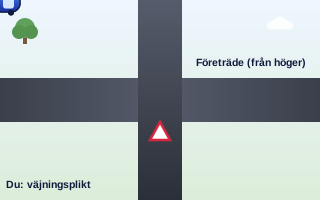
- A vehicle coming from the right has priority; if you're coming from the left, you must yield.
- This applies not only at intersections, but anywhere vehicles' paths cross.
- The right-hand rule does not apply:
- On priority roads (huvudled).
- Where traffic signals are working.
- In roundabouts.
- Where a yield or stop sign is posted.
- When a driver is leaving an acceleration lane.
- When reversing.
- When exiting onto a road (see the exit rule below).
- The turning rule:
- When turning, you must yield to oncoming traffic.
- Pedestrians and cyclists on the road you're turning into also have priority, even without a crosswalk or cycle crossing.
- The exit rule:
- Gives you a duty to yield when driving out onto a road from a parking area.
- Also applies when exiting a property, petrol station, or similar.
- Also applies when exiting a pedestrian street, a walking-pace zone, a cycle street, a road shoulder, or open terrain.
- Also applies when you cross a footpath or cycle path on your way out onto the road.
- The blocking rule: never enter an intersection or crosswalk if you risk getting stuck there and blocking others.
- The bus rule:
- At 50 km/h or below, you must yield to a bus signalling to pull out from a stop in the right-hand lane.
- Above 50 km/h, it's instead the bus that must yield to you.
- You must always yield to:
- Emergency vehicles with blue lights and/or siren.
- Trains and trams.
- Military convoys.
- Processions, such as a supervised group of children or a funeral procession.
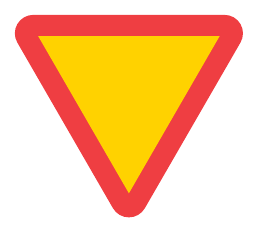
- A triangle with a red border = yield — slow down so you can stop if needed.
- An octagonal STOP sign = always come to a complete stop at the stop line, no matter the traffic situation.

- Priority road (blue sign, yellow diamond) = you always have priority over a connecting side road.

- At a traffic signal:
- Red: stop.
- Red and yellow together: get ready, but wait for green.
- Yellow: stop, if you can do so safely.
- Flashing yellow: the signal is out of order — drive with extra care and follow the road signs or the right-hand rule.
Practice questions:
Right-of-way rules »