
Personbil (B-körkort) — free English preview
Trafikregler
Stopping & parking
- Stopping = a brief halt (e.g. letting someone in or out).
- Parking = leaving the vehicle unattended, or for a longer time.
- You must never obstruct other road users, for example:
- Near intersections.
- At crosswalks.
- At emergency-vehicle access routes.
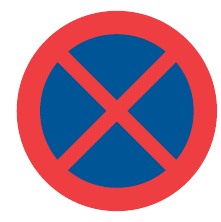
- Forbidden to stop (and therefore also to park):
- Where a "no stopping or parking" sign is posted.
- At a solid yellow line.
- In a road junction and within 10 metres of it.
- Where you block visibility, such as in a curve or at the crest of a hill.
- Where you block a road sign from view.
- In a tunnel or underpass.
- In a roundabout, a bus lane, or a cycle lane.
- At a level crossing with a railway or tramway.
- On a motorway or expressway.
- Within 10 metres before (but not after) a crosswalk, cycle passage, cycle crossing, or a crossing footpath or cycle path.
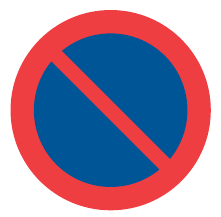
- Also forbidden to park (a brief stop is still allowed):
- Where a "no parking" sign is posted, or at a dashed yellow line.
- Within 30 metres before and after a railway or tramway crossing.
- Facing against the direction of traffic, i.e. on the wrong side of the road.
- On a priority road, unless a parking sign shows it's allowed.
- So that you block someone's exit or driveway.
- Next to another vehicle (double parking) — the exception is parking next to a two-wheeled vehicle.
- So that a wheel ends up outside a marked parking bay.
- General rules for stopping and parking:
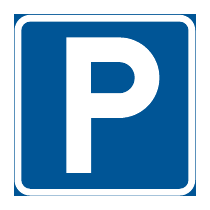
- A stand-alone blue P sign allows parking for up to 24 hours on weekdays — parking is unlimited on Saturdays, Sundays, and public holidays.
- If you use a parking disc, round your arrival time up to the next half hour.
- It's forbidden to leave the keys in a parked car.
- Never leave children or pets alone in a parked car in summer.
- Stop or park as far from the middle of the road as possible, and normally on the right-hand side.
- Turn on your parking lights if you park along a road in the dark.
- Turn your front wheels toward the kerb when facing downhill, and away from the kerb when facing uphill, so the car can't roll into the road.
- A vehicle can be towed away if it:
- Is parked illegally.
- Obstructs traffic or road maintenance.
- Is not roadworthy.
- Always check local signs and time restrictions before parking.
Practice questions:
Stopping & parking »That's as far as the English translation goes for now.
We're translating more of the course regularly. You can keep reading this chapter in Swedish, or explore the rest of the course.